The global market for shipping containers held flat last week: the weekly Xeneta market update (July 2026) reports that ocean freight rates stayed largely stable. At the same time, gCaptain points to mild upward pressure on the spot market now that peak season is getting under way. In this briefing you'll read what those two signals together mean for the shipping container price per metre at Europe's depots and for your timing to buy.
According to the Xeneta Weekly Ocean Container Shipping Market Update for July 2026, ocean freight rates stayed largely flat last week. Xeneta analyst Peter Sand describes a market without sharp moves: no carrier-announced increases, but no clear decline either. That points to a market in balance.
gCaptain (July 2026) strikes a slightly different note: on the key Asia–Europe and transpacific routes there were moderate rises on the spot market, while demand stayed firm as the run-up to peak season begins. The two sources don't contradict each other — they look at slightly different routes and moments. Together they show a stable picture with mild upward pressure heading into autumn.
Ocean freight rates move with the balance between shipping capacity and the demand for transport. As peak season approaches, demand picks up and carriers want their ships better filled; that nudges rates slightly higher, as gCaptain describes. If capacity stays ample and there are no major disruptions, the broad picture stays flat — exactly what Xeneta reports.
These global rates feed mainly into the new-build price of containers, because supply from Asia is part of that cost base. For second-hand containers at Europe's depots, it's mainly regional supply and demand that count. If you'd like to read up on the wider trade-off between new and used, our article on buying a new or used shipping container can help.
A stable world market usually translates into a steady pricing trend at Europe's depots: no sudden jumps, but the usual fluctuation from local supply and demand. For anyone looking to buy a second-hand shipping container now, that's favourable — there's no indication that waiting until after the summer will yield a lower price.
A common question is what a container costs per metre. That shipping container price per metre isn't a fixed rate, but works out more favourably the longer the container is: a 40ft costs more than a 20ft, but less per linear metre, because fixed costs such as transport and handling are spread over more length. The starting prices below show the level per size for your branch.
From those starting prices, the price per metre more or less follows on its own. A 20ft is roughly 6 metres and starts at from €1.500 used or on request new; a 40ft is roughly 12 metres and starts at from €2.000 used. Because the length doubles but the price rises by less than double, the figure per metre is lower for a 40ft. Anyone chasing loading volume above all should therefore also look at the 40ft High Cube container: the same length, but 30 centimetres of extra internal height and so more cubic metres for very nearly the same price per metre. A full overview is in which shipping container size to choose.
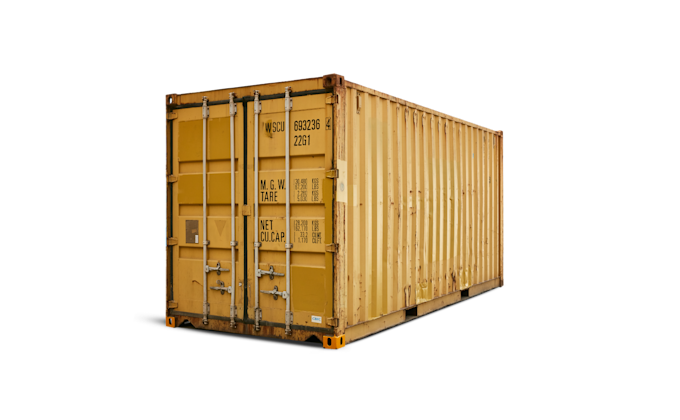
Reliable 20ft standard container, wind & watertight, ideal for storage or transport.
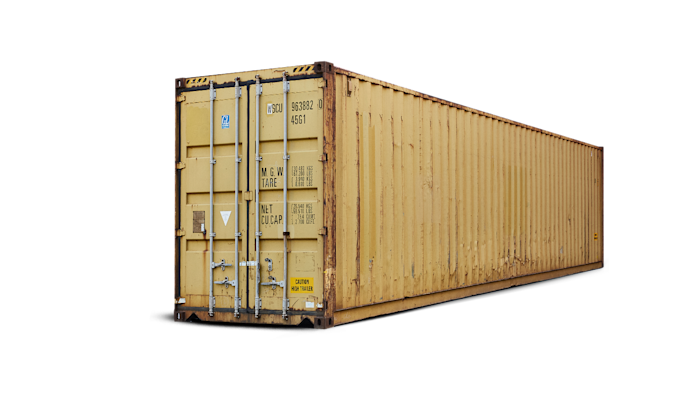
Extra height 40ft HC container — 2.70m internal height for maximum volume.
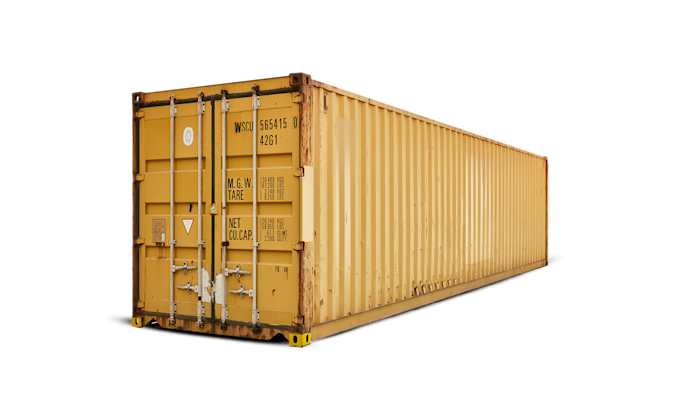
Spacious 40ft standard container with double doors, perfect for larger storage needs.
With a purchase, transport is a separate cost item that stands apart from global freight rates: it depends on the distance to the depot and how accessible your location is. So factor it in separately. You can read more about this in container transport costs.
The starting prices above are live, but an exact figure including transport depends on your type of container and delivery location. Let us know those, and on working days we'll send a quote by email within the hour.
In a stable market there are no signals pointing to a sharp decline worth waiting for. The mild upward pressure gCaptain sees heading into peak season argues more for deciding in good time than for holding off. More important than the exact moment is that you buy based on your needs and pay in a safe way: at HEROX you can buy safely without a middleman, with the option to pay after delivery or finance in instalments.
If you're torn between buying and using one temporarily, read buying or hiring a shipping container. And when buying, always check inspection and warranty, as set out in what to look out for.
In the shop you'll find current stock and starting prices per size and condition for your region. Compare new and used and decide at your own pace which container suits your situation.
There's no fixed rate per metre. The price per linear metre works out lower the longer the container is, because fixed costs such as transport and handling are spread over more length. A 40ft of roughly 12 metres therefore costs less per metre than a 20ft of roughly 6 metres. For an exact figure including transport, HEROX sends a quote within the hour on working days.
Flat rates, as Xeneta reports in July 2026, point to a market in balance. That usually translates into a steady pricing trend at Europe's depots, with no sudden jumps. The level for used containers also depends mainly on regional supply and demand, so always request an up-to-date quote for an exact figure.
The sources look at slightly different routes and moments. In July 2026 gCaptain points to a moderate rise on Asia–Europe and transpacific routes heading into peak season, while Xeneta describes the broad picture as flat. Together they show a stable market with mild upward pressure in the run-up to autumn.
In a stable market there are no signs of a sharp decline worth waiting for. The mild upward pressure heading into peak season argues more for deciding in good time. Above all, buy based on your needs and pay safely, for example after delivery. A used 20ft container starts at {{price:20ft:used}}.
A 40ft High Cube has the same length as a standard 40ft, but 30 centimetres of extra internal height and so roughly 76 rather than 67 cubic metres of loading volume. For very nearly the same price per metre you get more volume, which is handy for bulky loads or conversions with insulation and a ceiling.
View live stock with prices, or get a tailored quote within one business hour.


